
10 Oct 2026 2 min read
Heat Pump vs Solar Water Heater: How to Choose
Both cut the electricity used for hot water, in different ways. A practical comparison of reliability, roof space, cost drivers and why many buildings combine them.
Read moreHouse of Solar (HOS) is a solar water heater supplier in Jaipur offering domestic and commercial systems — from rooftop units for homes to centralized solar hot-water systems for hotels and hospitals — with installation and maintenance.
Quick answer
A solar water heater suits buildings with shadow-free roof space and regular morning or evening hot-water use. It heats water with sunlight and stores it in an insulated tank, while a heat pump or electric backup covers cloudy days. House of Solar supplies and installs domestic and commercial solar water heaters in Jaipur.
A solar water heater uses a collector on the roof to absorb sunlight and heat water, which is stored in an insulated tank for use through the day and the next morning.
Most domestic systems use the thermosiphon principle: heated water becomes lighter and rises into the tank above the collector without a pump. Larger commercial systems use pumps and controllers to move water between collector banks and storage tanks.
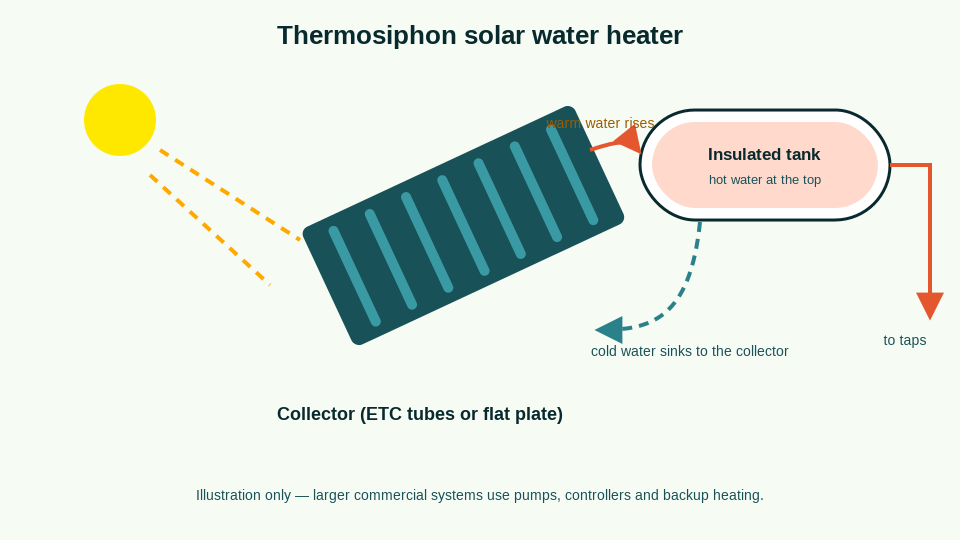
Evacuated tube collectors (ETC) work well in cooler weather and are usually economical, while flat plate collectors (FPC) are sturdier and generally better suited to hard water.
Where water is hard — as it often is with borewell supply — a water softener or a system with a heat exchanger helps either type last longer.
Glass tubes with a vacuum layer reduce heat loss. With hard water, scale can build up inside the tubes, so water quality matters.
Metal absorber plates with water channels under toughened glass. Often preferred for hard water, commercial duty and higher-pressure systems.
| ETC (evacuated tube) | FPC (flat plate) | |
|---|---|---|
| Construction | Glass vacuum tubes | Metal absorber under toughened glass |
| Hard water | Tubes can scale — softened water advised | Generally more tolerant; softening still helps |
| Cool weather | Lower heat loss | Higher heat loss than ETC |
| Durability | Tubes can break but are replaceable | Sturdy panel |
| Typical use | Homes and smaller systems | Commercial systems and hard-water sites |
A commercial solar water heater uses banks of collectors and large insulated tanks, usually with a heat pump or other backup, to supply hotels, hospitals and hostels.
Solar water heating for hotels and solar water heating for hospitals is most effective as pre-heating: the sun does as much as it can, and the backup tops up to the set temperature in the morning or on cloudy days.
A centralized solar hot-water system feeds the building through the same storage and recirculation as a heat pump plant — see centralized hot-water systems.
Size depends on how much hot water you use per day, the number of bathrooms and users, the roof area available and how much backup heating you want.
Solar water heater installation involves placing the collector and tank on a sound, shadow-free roof, connecting the cold and hot lines, insulating the pipes and adding the right valves.
We check the roof’s load-bearing capacity, water pressure and the pipe route to bathrooms, and keep hot-water pipe runs short and insulated so less heat is lost on the way.
The solar water heater price in Jaipur depends on capacity, collector type (ETC or FPC), tank material, the stand and pipework, and any backup heater or controller.
Commercial systems also depend on the number of collector banks, pumps and controls. We quote after seeing the roof and understanding your hot-water use.
Keep the collectors clean, check for leaks and broken tubes, flush or descale the tank periodically, and check valves and the backup heater.
Solar water heater maintenance in Jaipur matters most where dust settles quickly and water is hard. We offer maintenance visits for systems we install and for existing systems.
A few photos and numbers are enough to start.
Roof, shadows, water quality and pressure, and hot-water use.
Collector type, capacity, tank and backup recommended in writing.
Stand, collector, tank, plumbing, insulation and valves.
Testing and guidance on daily use and backup settings.
Cleaning, descaling and repairs when needed.
Yes, on sunny winter days, though the water may not get as hot and more backup heating may be needed in the morning. We size the collector and tank with winter use in mind.
In most cases yes, for cloudy days and heavy-use mornings — an electric element, an existing geyser or a heat pump.
Possible causes are heavy use the evening before, a long uninsulated pipe run, scale in the collector, or a tank that is too small for the use. A service visit checks each of these.
It depends on water hardness and use. In hard-water areas, periodic flushing and descaling — or a water softener — keeps the system working well.
Yes, as a commercial system with collector banks and large tanks, usually with heat pumps as backup in a centralized hot-water system.
10 Oct 2026 2 min read
Both cut the electricity used for hot water, in different ways. A practical comparison of reliability, roof space, cost drivers and why many buildings combine them.
Read moreRequest a site survey — we size the system to your building and explain the options.