
10 Oct 2026 2 min read
Heat Pump Sizing for Hotels: A Practical Method
How to size heat pumps and storage for a hotel — peak demand, recovery time, back-of-house loads and standby capacity — without guesswork.
Read moreHouse of Solar (HOS) helps hotels and resorts in Jaipur and across Rajasthan plan hot water, rooftop solar and water treatment as one system — from heat pumps for hotels and centralized hot water plants to solar power for resorts.
Quick answer
Start with hot water: a centralized heat pump plant with insulated storage and recirculation usually replaces resistance heating; rooftop solar can then supply daytime power, and water treatment prevents scaling. House of Solar surveys the hotel, sizes these systems together, and installs and maintains them in Jaipur and across Rajasthan.
Hotel energy-saving solutions reduce the energy a hotel needs for the same guest comfort — for example heat pumps for hot water, rooftop solar for daytime power, insulated pipes and tanks, and treated water that keeps equipment efficient.
In most hotels, hot water for rooms, kitchens and laundry is one of the largest daily energy uses, so it is usually the first system we study. The actual reduction depends on your current equipment, tariff, occupancy and operating hours, which is why we work from a site survey and your utility bills rather than generic percentages.
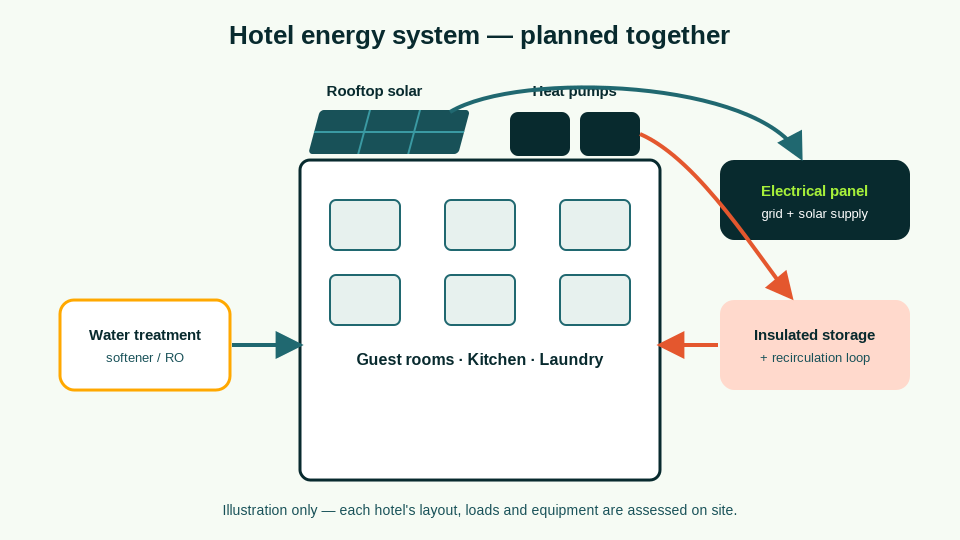
A heat pump for hotels heats water by moving heat from the air, so it uses less electricity than resistance heaters for the same hot water and keeps working at night and in winter.
Our hotel heat pump solutions include standby capacity, so one unit can be serviced while guests continue to get hot water.
A central plant with storage and recirculation gives guests hot water quickly at every floor, even at the morning peak.
Back-of-house loads may need higher temperatures or a separate circuit; we size them separately from the room demand.
Where a unit is designed for pool heating, a heat pump can maintain pool or spa water temperature in cooler months.
A heat pump for resorts is planned around the site layout — spread-out cottages may need more than one plant or a longer insulated loop to keep hot-water delivery quick.
We compare one central plant with several smaller cluster plants, considering pipe lengths, heat loss, pumping and maintenance access before recommending a layout.
Most mid-size and large hotels benefit from a centralized hot water system; small properties or scattered buildings may suit separate plants.
Our centralized hot water systems page explains the components — heat source, storage, recirculation and controls — and how we size them.
Hotels and resorts can use rooftop or ground-mounted solar to supply part of their daytime electricity, including power for heat pumps, kitchens and common areas.
Solar power for resorts often has more space available than city hotels, while city hotels may use rooftops and car-park structures. Sizing depends on daytime load, available shadow-free area and grid connection rules. Our commercial solar EPC page covers hotel solar power plants in detail.
Energy-efficient MEP solutions in a hotel come from right-sized equipment, insulated hot-water pipes and tanks, controlled recirculation, and water treatment that prevents scaling.
For new projects we coordinate our hot-water, solar and water-treatment scope with your architect and MEP consultant; for running hotels we plan work around occupancy so guests are not disturbed.
Recent bills and a walk-through of the plant room help us give a realistic first proposal.
Occupancy pattern, hot-water use, utility bills, existing equipment and water quality.
Heat pumps, storage, solar and water treatment sized together, with options and phasing.
Work scheduled around occupancy, with shutdown windows agreed in advance.
Testing at far rooms, control settings and staff guidance.
Preventive maintenance for heat pumps, solar plant and water treatment.
Room count and typical occupancy; kitchen, laundry, pool and spa hot-water use; recent electricity and fuel bills; existing equipment; and the space available on the roof and in the plant room.
Yes, where the unit is designed for pool heating. It is sized from the pool area, whether a cover is used, the location and the temperature you want to hold.
We plan noisy work and shutdowns around occupancy and agree changeover windows with the hotel in advance.
Often. Resorts with spread-out cottages may need several smaller plants or longer insulated loops; city hotels usually suit one central plant.
Yes. The heat pumps can be scheduled to reheat storage while the rooftop solar plant is generating, so more of the daytime solar power is used on site.
Yes — we offer preventive maintenance and annual maintenance contracts for heat pumps, solar plants and water treatment.
10 Oct 2026 2 min read
How to size heat pumps and storage for a hotel — peak demand, recovery time, back-of-house loads and standby capacity — without guesswork.
Read more10 Oct 2026 2 min read
A step-by-step method to size rooftop solar for hotels, hospitals, schools and factories: daytime load, roof area, yield and grid-connection rules.
Read moreRequest a site survey — we size the system to your building and explain the options.